
Where Madera City Directories Survive
Begin with discovery, not an assumed complete shelf. The California State Library's directory and telephone-book databases point to call numbers and surviving issues. The Madera History Room, NARA, and CAGenWeb add local and historical targets. A catalog range is not proof that every year survives.
| Collection | Years | Where Held/Discovered | Access/Use |
|---|---|---|---|
| Polk's Madera city directories | Commonly cataloged 1924-1977; exact issues unverified | State Library catalog; Madera History Room inquiry | Alphabetical lookup; check each issue for reverse pages |
| CAGenWeb Madera material | 1871 and 1883 Fresno-area extracts; 1914 claim; 1920 A-F partial | CAGenWeb Madera database | Secondary finding aid; corroborate originals |
| Merced-Madera NARA directories | 1914, 1917, 1920, 1922, 1926-1931, 1935 | NARA 1930 city-directory inventory | Verified request targets; shelf location not implied |
| Madera-area telephone books | Exact issues not located | State Library Telephone Book Database; local inquiry | Subscriber, number, and service-address clues |
| Federal population census | Public through 1950 | NARA and partner access | Households, location, occupation, birthplace |
| Recorder indexes | 1893-1979 historical; mid-1980-present current | Madera Clerk-Recorder online and counter | Name continuity for owners, not a directory shelf |
The table separates discovery from custody. The State Library points to holdings, NARA supplies an inventory, and CAGenWeb offers transcriptions. Ask the local library whether an issue is on hand, on microfilm, or available by reference request. No uninterrupted Polk run or complete telephone-book run was verified.
Reading Madera City Directory Entries
A Madera city directory entry is a compact clue set. A surname may be followed by a given name or initial, spouse in parentheses, occupation or trade, and a residence address. Business entries can name a firm, proprietor, trade, and business address. Read the title page and abbreviation key before treating a short mark as a fact, because publisher and issue conventions change.
| Name | Surname first, then given name or initials; a spouse may appear in parentheses. |
|---|---|
| Occupation | A trade or occupation, sometimes paired with a business or firm entry. |
| Address | House number and street; “r” can mean residence, “h” home, and “bds” boards. |
| Owner/occupancy mark | Some issues use a mark for ownership or occupancy; absence of a mark proves nothing. |
| Widow notation | “wid” followed by a name can preserve a relationship clue for family history. |
| Business line | Firm, proprietor, partner, trade, and business address when the issue lists them. |
- Criss-cross directory
- A reverse street section arranged by street and house number, if included in that issue.
- Householder index
- An index centered on the person or household at an address, distinct from an ordinary surname list.
- Abbreviation key
- The volume's guide to short marks. Read it before interpreting “r,” “h,” “bds,” “wid,” or a tenure symbol.
Record the page, exact spelling, street number, spouse, and mark as printed. A directory is historical evidence, not an identity certificate.
Madera City Directories in State Library Catalogs
The California State Library city and county directory catalog is the discovery route for call numbers and surviving years. Its Madera research guide adds telephone books, newspapers, maps, county histories, manuscripts, and government records. Search “Madera” and a Madera County city, then save the title, publisher, year, and holding library.
Local access starts with the Madera County Library History Room at 121 N. G Street, telephone 559-675-7871. Ask for the shelf list and reader rules. State-held volumes may require a Sacramento reading-room visit or reference request. The Historical Society and Museum offers local leads, but a current issue list was not located.
The State Library catalog image is a useful starting point because it identifies the discovery system rather than implying that a scanned page is online.
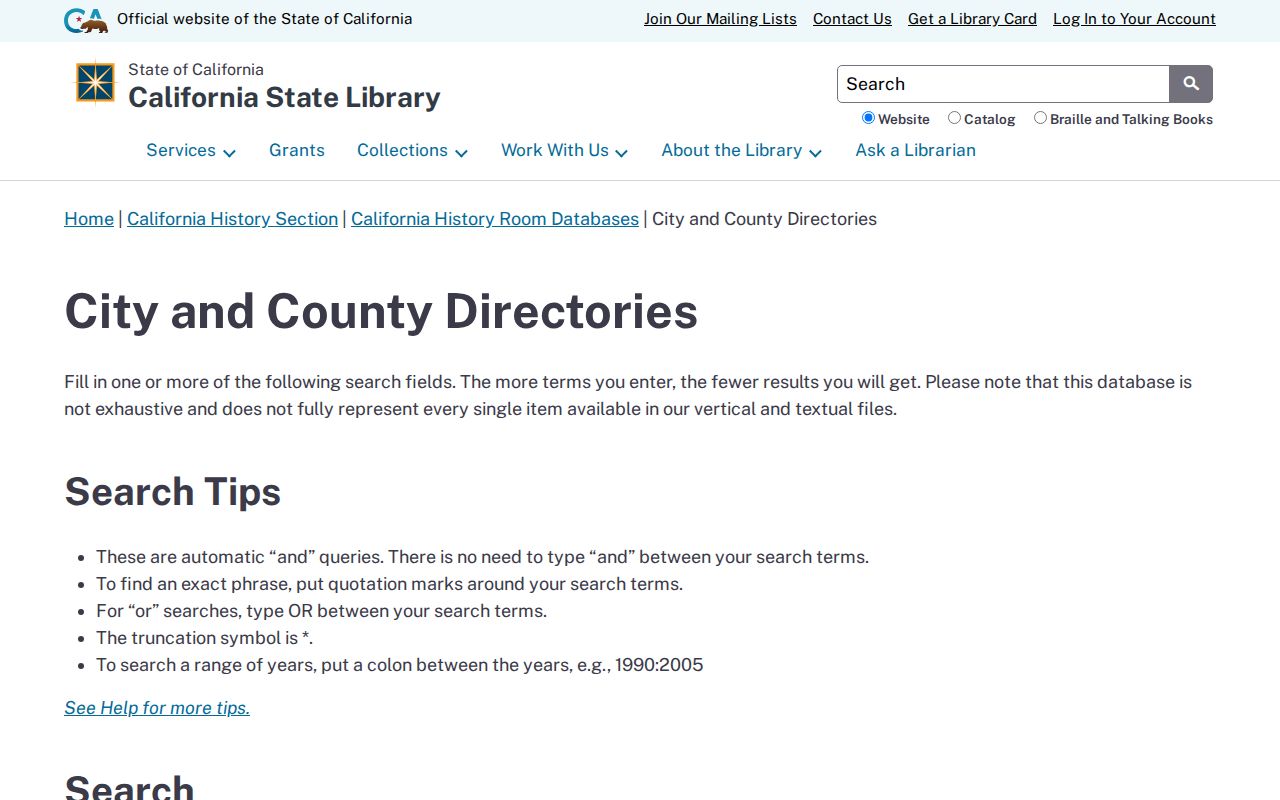
Use the catalog record to make a precise request, then let the holding library confirm whether the physical volume or a readable copy exists.
Polk's Madera Directory Range
Bibliographic evidence commonly places R. L. Polk's Madera city directories from 1924 to 1977, but the exact issue list and local shelf inventory are unverified. Treat that span as a cataloged range, not an uninterrupted run. Request a particular year and ask the library to confirm it.
CAGenWeb adds earlier leads, not proof of a complete collection. It identifies a claimed 1914 Madera City Directory, a partial 1920 A-F directory, and 1871 and 1883 Madera-area extracts from Fresno County directories. Church records, graduate lists, physicians' certificates, an Old Timers Register, and local indexes offer more leads. Corroborate each with an original, newspaper, census, or custodian-held record.
The CAGenWeb Madera search collection shows why an early rural-route entry can matter when a modern numbered street search fails.
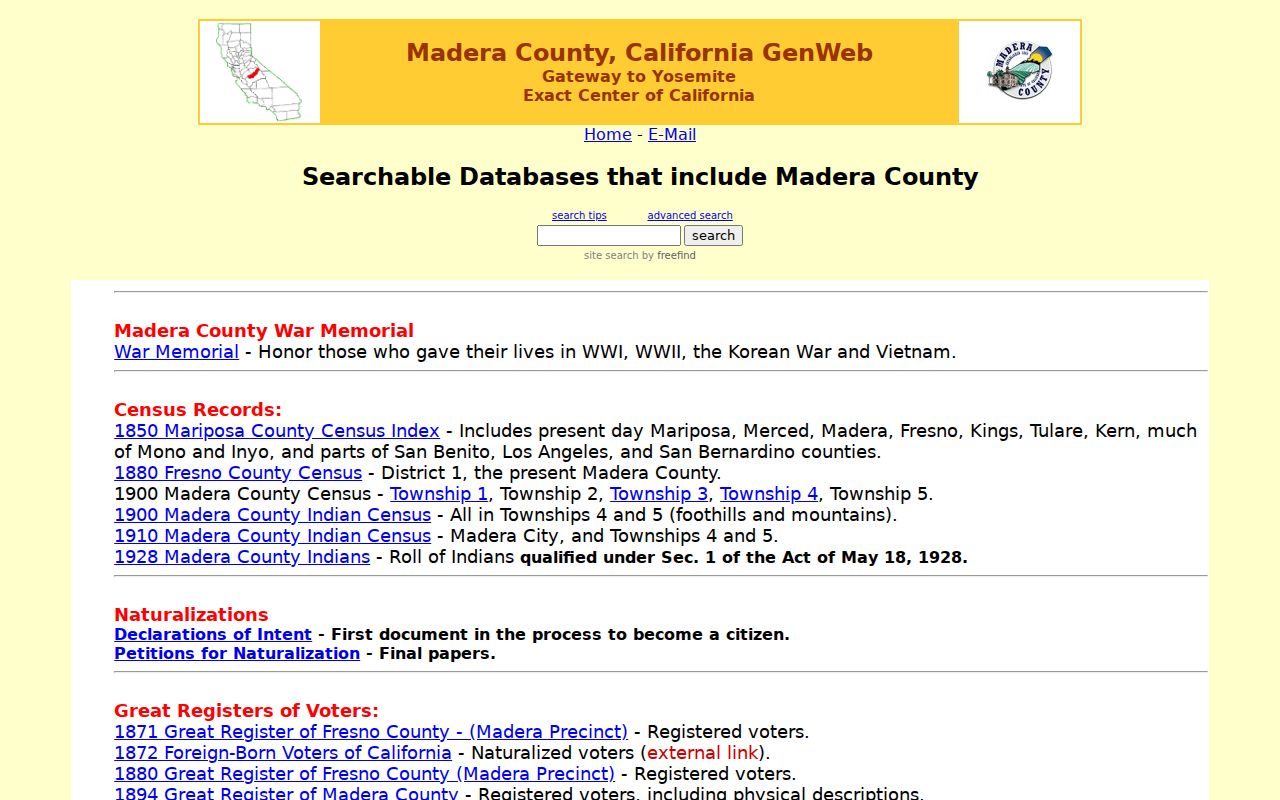
Use the image's source route as a finding aid, then cite the original volume or record that confirms the name and address.
Madera Alphabetical and Reverse Directories
Alphabetical pages start with a surname and may show a given name, spouse, trade, and residence. A reverse or criss-cross section starts with street and house number. Not every Polk issue has one, and a telephone book may cover more than Madera city limits.
Move between the modes. Find a name alphabetically, copy its address, then test that address in reverse pages from the same or a nearby issue. If a name is missing, check the title-page scope, rural routes, exchange, and publication year. Modern parcel work belongs with GIS and the Assessor.
For address-keyed records in the present, the Madera by-street records route adds parcel, tax, permit, and deed checks without pretending that a directory lists every occupant.
Madera Phone Books Fill Directory Gaps
Telephone books can fill a missing directory issue, but they answer a narrower question. A listing may preserve a subscriber, number, and service address. The exchange may cover more than Madera's boundary. Exact issues were not located, so use the State Library Telephone Book Database and Madera History Room rather than assuming a run.
Phone books have absences. A person may have moved after press, used another spelling, appeared under a spouse, lacked a listing, or lived on a rural route. Compare the line with census schedules, newspapers, deeds, permits, or an obituary. It is a dated lead, not proof of one household.
Tracing Madera City Directory Families
A five-step trace works best when each issue is treated as a dated snapshot. Start with a known name, address, or census household. Copy the exact spelling and every clue before moving to the next year.
- Find the first appearance in an available Madera directory or telephone book and record the issue, page, name, spouse, address, and mark.
- Follow the name forward one issue at a time, noting a new street, changed initial, spouse, trade, or “removed” notation.
- Flip to the reverse section, when present, to test the house number and see which nearby names share the street context.
- Pair directory years with the 1930, 1940, and 1950 census schedules, using the census household, birthplace, occupation, and location to test identity.
- Close the trail with newspapers, an obituary, cemetery office records, probate, or a civil record, then cite the custodian and access path.
A missing name can mean a move, death, a publication gap, a rural route, a different spelling, a private or absent listing, or a household recorded under another person. Compare the nearest census and newspaper dates before choosing one explanation.
Madera Census and Directory Timeline
The timeline keeps separate record systems from being treated as one continuous directory. Madera County's creation is the local boundary; NARA dates identify particular Merced-Madera targets.
| 1893 | Madera County was created from Fresno County territory; earlier local trails may remain in Fresno records. |
|---|---|
| 1914 | CAGenWeb reports a Madera City Directory, and NARA lists a Merced-Madera directory issue. |
| 1917, 1920, 1922 | NARA lists Merced-Madera issues; CAGenWeb describes the 1920 Madera material as partial A-F. |
| 1924-1977 | Polk's commonly cataloged bibliographic range; exact surviving issues remain unverified. |
| 1926-1931, 1935 | NARA lists additional Merced-Madera directory targets for census research. |
| 1950 | The newest public federal population census schedule under the 72-year access rule. |
| 1893-1979 / mid-1980-present | Madera Recorder historical and current index split, useful for ownership continuity rather than household coverage. |
The NARA Merced-Madera city-directory inventory supplies request targets without claiming that every volume sits on a Madera shelf.
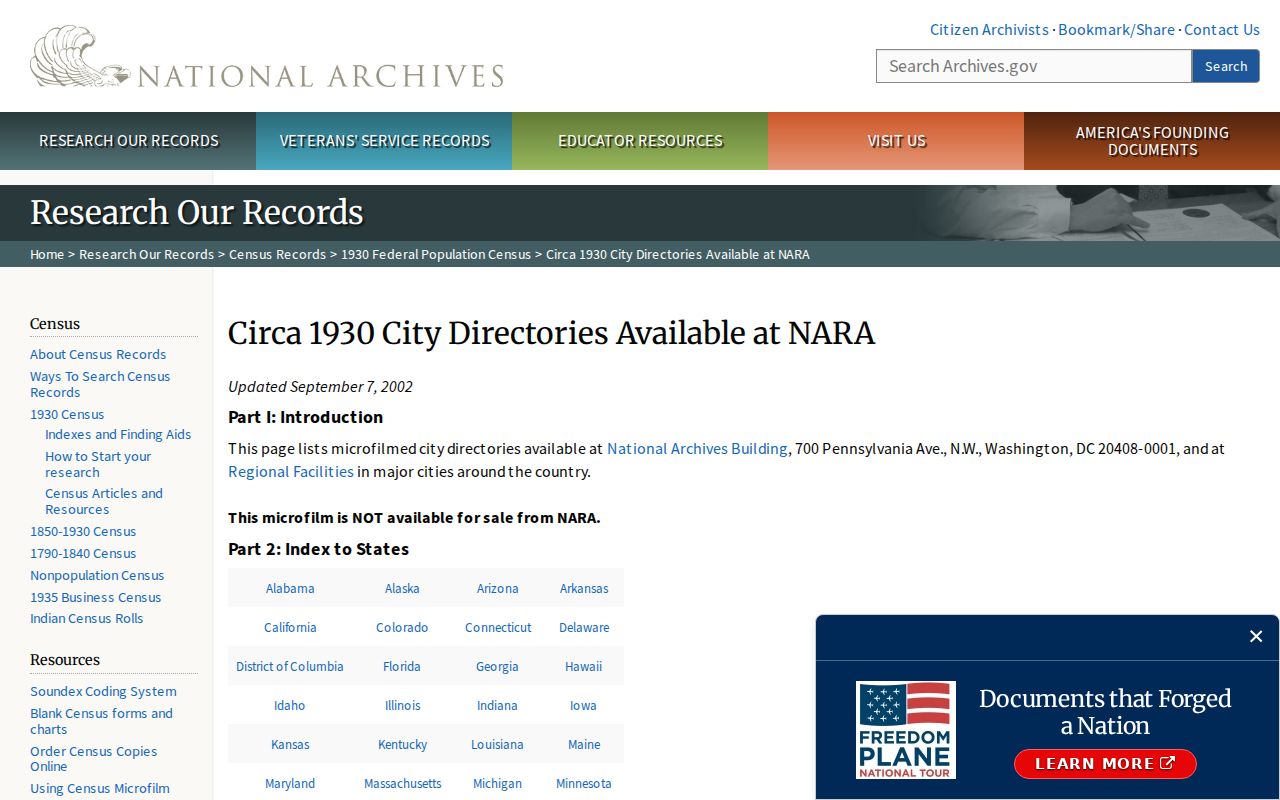
Pair a directory issue with a nearby census rather than forcing a directory to answer a question its scope cannot support.
Madera Directory and Census Access Through 1950
Federal census schedules are public through 1950 under the 72-year rule. They add household composition, location, birthplace, and occupation to the shorter city directory line. NARA and partner services provide access; a library desk can help with county, enumeration area, or spelling.
The census does not replace a directory volume. A directory may supply a street number between decades, while a census can show people not listed in a volume. Compare names, ages, birthplaces, roles, and addresses, keeping the issue date beside each conclusion.
The NARA census access overview explains the federal collection and closure rule that sets the public boundary.
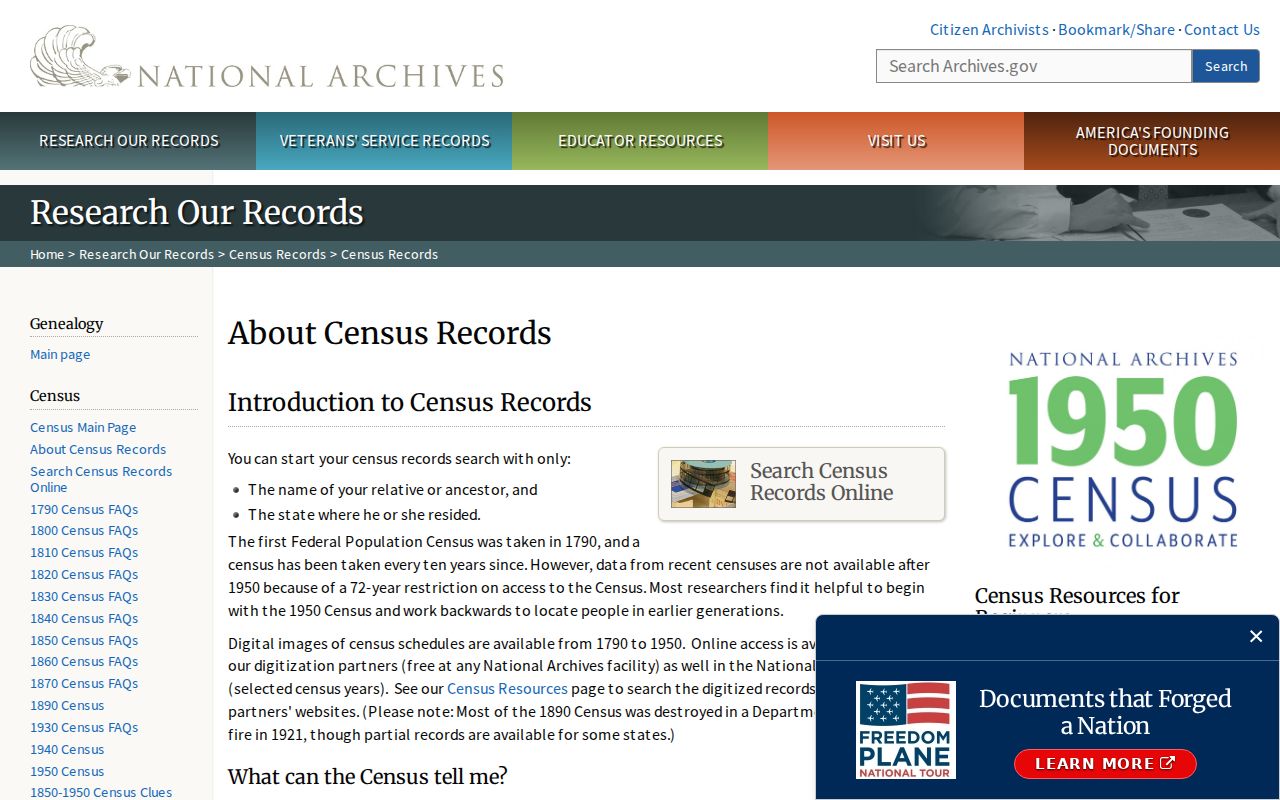
That federal context helps separate a missing local volume from a census schedule that is simply not public yet.
Why Madera Directory Names Go Missing
Absence from a Madera city directory is weak evidence. Coverage may be limited to a city, exchange, or route. An issue may be partial, a name may appear under a spouse, or an accented, hyphenated, or compound surname may be normalized. Movers, minors, people without telephone service, and unlisted people can leave no line.
Use a gap-aware search: test surname order, initials, spaces, hyphens, maiden and married forms, and accented and unaccented spellings. Compare the nearest directory with a census, newspaper, deed, probate file, cemetery record, or vital record. A transcription remains a lead until an original confirms it.
Before 1893: Madera in Fresno Records
Madera County began in 1893, so earlier residents may be filed under Fresno County, federal land sources, church registers, newspapers, or state collections. An 1871 or 1883 Fresno-area extract may matter, but its geography must be checked before attaching it to a town or address.
Use the State Library guide for maps, county histories, newspapers, and archives. CAGenWeb's early extracts and 1914 claim can point to a source; NARA's later Merced-Madera inventory can point to a federal issue. Keep “discovered in,” “held by,” and “confirmed by” separate.