
Madera Previous Residents: Source Eras
A Madera house history assigns each source a purpose. The parcel map fixes the location, the assessment record supplies a lead, and the recorder connects parties through deeds. Directories, census schedules, permits, newspapers, obituaries, and probate files fill gaps. No single roll contains every person at an address.
| Source | Years It Covers | Where Held | What It Shows |
|---|---|---|---|
| County GIS and Assessor | Current | Madera map and parcel services | Situs, APN, legal description |
| Recorder index and instruments | 1893-present | Madera Clerk-Recorder | Parties, instruments, dates, title chain |
| Polk's city directories | 1924-1977 range; issues vary | State Library and History Room | Names, addresses, reverse entries when present |
| Telephone and reverse directories | Issue years not located | State Library and local inquiry | Subscribers and nonowner occupants |
| Federal census | 1850-1950 public | NARA and partner databases | Households, locations, occupations, birthplaces |
| City building permits | Cutoff not stated | Building Department and CPRA | Site, dates, disclosed actors |
| Sanborn maps | Madera editions not verified | LOC and local catalogs | Footprint, use, old number where covered |
Start with GIS and the Assessor for a current situs, APN, and legal description. Move to the recorder for ownership, directories and census schedules for households, and permits or newspapers for dated activity. The county recorder begins in 1893, when Madera County was created from Fresno County. Earlier trails belong in Fresno County, federal, church, or state collections. A directory is not a deed, and an assessment roll is not proof of occupancy.
Madera Previous Residents Start with a Parcel
Fix the present parcel before looking for past residents. The Madera County GIS application gallery reaches map tools whose locator accepts an address or APN and zooms to the parcel. Parcels, roads, cities, zoning, census blocks, precincts, and county boundaries separate a city address from nearby unincorporated territory. Adjacent parcels can be viewed by clicking and panning, but no verified radius tool was found.
The Madera County Assessor parcel gateway directs users to ParcelQuest Lite and a second-floor public counter. Use the counter or authorized county data when a current owner is needed because web owner-name availability is not promised. The tax service searches a street address, assessment number, or fee parcel, but suppresses the assessed owner. Keep situs, mailing address, APN, and legal description separate. That parcel anchor keeps previous residents tied to the right land rather than to a loose street label.
Note: A current parcel is the anchor for previous residents, while the street number is only one label for that land.
Madera Previous-Resident Deed Chain
The recorder cannot search by street address or APN. Once the situs, APN, and legal description are fixed, obtain the current owner through the Assessor counter or authorized county data, then search that owner as grantee in the Madera County recorder index. The instrument supplies the prior party, date, reference, and legal description for the next search.
- Record the situs, APN, legal description, and owner source.
- Search the owner as grantee around the acquisition year, using spelling variants.
- Read the seller or grantor, then search that party as grantee for the earlier purchase.
- Compare legal descriptions, dates, and references before joining names.
- Use 1980-present digital images, then the 1893-1979 historical index and microfilm; before 1893, shift to Fresno County.
- Grantor / grantee
- The grantor gives or transfers an interest; the grantee receives it.
- Chain of title
- The linked sequence of recorded transfers that connects a present interest to earlier parties.
- Legal description
- The formal land description used in an instrument. It can identify the parcel when a street number changes.
- APN
- The parcel number that joins map, assessment, and tax systems before the recorder search is made by name.
Madera Past Residents in Directories
Ownership is only half of a past-resident trail. The California State Library's Madera County research guide sends researchers to its city-directory and telephone-book databases. Search “Madera” and the city name, then ask the History Room at 121 N. G Street for shelf guidance. Polk's Madera directories have a catalog range from 1924 into 1977, but exact issues and gaps must be checked.
A reverse or criss-cross section leads from street and house number to an occupant or business. Alphabetical entries may add an address, spouse, occupation, or abbreviations such as “r,” “h,” “bds,” and “wid.” Telephone books can supply a subscriber and service address, though exact runs were not located. CAGenWeb lists a 1914 directory, a partial 1920 A-F directory, and 1871 and 1883 extracts. Treat these as finding aids and corroborate them.
Rural-route entries can lack a modern number. Women may appear under a spouse or as a widow, and a missing entry does not prove absence. Save the issue, page, spelling, address, and abbreviation key. Previous residents often surface first in this household layer, not in the deed index.
Madera Census Pairing for Past Residents
Federal census schedules add household context that deeds do not. The newest public schedule is 1950 under the 72-year release rule. NARA and partner databases can show household composition, location, occupation, and birthplace, but a place description may not match a later street label. Keep the enumeration district or locality wording with the result.
- Choose a known address, person, or deed year and write down every spelling and number variant.
- Find the closest Polk, telephone, or reverse-directory issue and copy the entry without modernizing it.
- Compare the entry with the 1930, 1940, or 1950 census household and note names, ages, relationships, and locality.
- Bridge the years between schedules with deeds, permits, newspapers, obituaries, or another directory issue.
Madera County was formed from Fresno County in 1893, so an earlier resident may be recorded in Fresno County schedules or land sources. A census match supports identity only when names, place, family links, and dates fit.
Note: Census and directory evidence can place a household near an address, but neither source proves ownership of the parcel.
Madera Records at the 1980 Divide
The Madera recorder's historical index covers 1893-1979, while the current index reaches from mid-1980 forward and updates daily. Online results are references, not remote images: 1980-present images are digital at the office, and 1893-1979 records are on microfilm. Search the party and year, then ask the counter to view the instrument.
Index and office viewing are free. A copy request can use a document number or book and page and may be emailed to RecorderInfo@maderacounty.com. Plain records cost $3 for the first page and $1 for each additional page; certification adds $2, and card payment adds $2.50. Recording is accepted weekdays 8 a.m.-4 p.m. at 200 W. Fourth Street; mail recording uses that address, and originals generally return in 2-3 weeks.
The index has no address or APN search. Use party-name variants and carry the legal description forward; statutory redactions affect some copies.
Note: The office counter and microfilm are part of the public access path, not a last resort after an online search fails.
Madera Previous-Resident Sanborn Maps
Library of Congress Sanborn maps can add a physical layer to a Madera house history. Where an edition exists, it may show a footprint, use, construction detail, and older number. Exact Madera editions were not verified, so read each sheet's date and legend and do not assume continuous coverage.
A changed street number is a clue, not a date. No formal Madera street-renumbering date was located. Use the legal description, APN, subdivision or survey map, and parcel geometry to bridge a change. If a sheet does not cover the block, use directories, deeds, and newspapers.
Sanborn sheets explain physical change, but cannot replace an instrument or establish an occupant.
Madera Records: 1906 Courthouse Caveat
The Madera County courthouse history records a Christmas Eve 1906 fire that destroyed the upper floors and tower, followed by rebuilding. The old courthouse later became the Historical Society museum in 1971. That history explains a change in buildings and custodians, but the authoritative account does not say that a particular deed book, census schedule, or directory series was destroyed.
The courthouse image supplies architectural context for the place where local history is now interpreted.
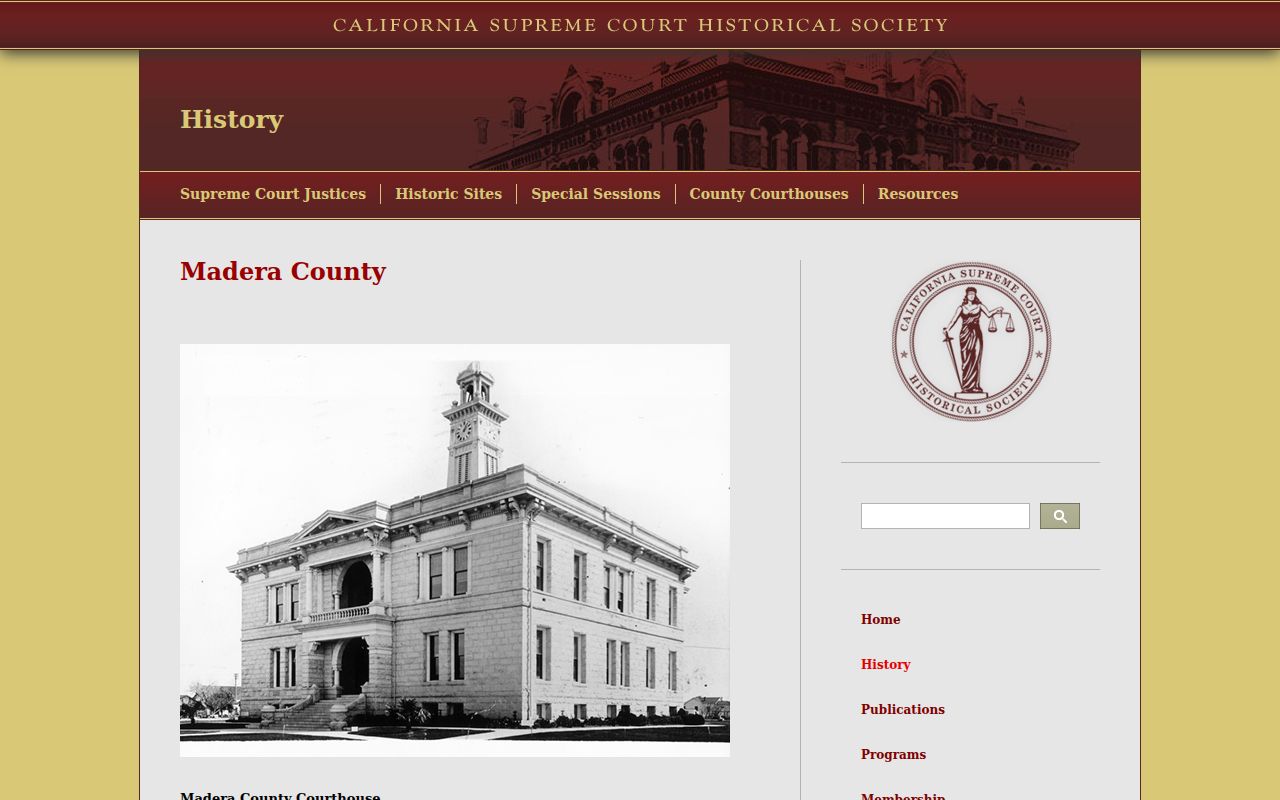
The fire should therefore be cited as a records-history caveat, not as proof of a missing Madera record. For an actual gap, ask the county clerk, library, State Library, or State Archives which series survives and whether a copy or reference request is available.
Madera Previous-Resident Probate Endpoints
When a deed chain reaches an owner who died, the Superior Court Probate Division adds the estate layer. Madera Superior Court keeps probate cases, petitions, wills lodged in a case, docket entries, and heir notices. The court online-services route leads to case information, but remote access is narrower than a courthouse terminal. Protected material remains restricted. A case number is the strongest copy key.
Obituaries and cemetery records can close a household trail when a directory ends. Use library newspapers, cemetery offices, historical-society leads, funeral-home notices, and California death-record channels. The county Recorder handles local copies and CDPH statewide records; informational and authorized copies have different rules. No official local obituary index or complete cemetery database was located, so corroborate secondary memorial entries.
Keep death date, last known address, and source type distinct from the deed chain.
Madera Previous-Resident Courtesy Notices
On May 15, 2025, Madera County began its Property Recording Courtesy Notification Program for grant deeds, quitclaim deeds, and similar title-changing instruments. A bilingual notice is mailed within 30 days to the Assessor mailing address. It is not a list of previous residents, but it shows why mailing and situs addresses are separate fields.
Compare the notice's date, type, number, APN, and parties with the recorder index and actual document. The county warns about forged deeds, liens, and paid title-lock pitches. The free index and published copy schedule help; questions go to 559-844-SCAM, 559-675-7724, or RecorderInfo@maderacounty.com.
Note: A courtesy notice points to a recent filing; it does not establish that a named person lived at the property.
Madera Downtown Counters for Past Residents
Madera's county-seat layout makes a multi-stop visit practical, with hours checked first. The Assessor and Recorder are at the Government Center, 200 W. Fourth Street; City Hall is 205 W. Fourth; Superior Court is 200 S. G; and the Library History Room is 121 N. G Street, 559-675-7871. Recorder services consolidated at the Government Center on May 1, 2025.
Use the City public-records route for existing city records. The Building Department's permit route can identify public site, work, applicant, owner, contractor, and date fields, subject to redaction. Fallbacks are counter viewing, microfilm, focused requests, library reference, the State Library catalog, and State Archives guidance.
Lawful house history. Deed, directory, census, and obituary research in Madera can support family history and personal curiosity. Do not use an old address trail to stalk, harass, track, or intimidate a living person.